Love Not War
They were not dreamers. They were the first generation to publicly name what was happening — that war was a business, the poor were the product, and love was the only rational response.
"They will never send their children to die for the rich."
This is not cynicism. This is the hard-won wisdom of a generation that watched their brothers, cousins, and neighbors come home in body bags — while the sons of senators and CEOs came home from college. The Flower Children did not hate soldiers. They loved them too much to let them be used as instruments of profit.
The Flower and the Bayonet
October 21, 1967. The Pentagon. 100,000 people. A young man named George Edgerly Harris III — known as "Hibiscus" — placed a carnation into the barrel of a National Guard rifle. Photographer Bernie Boston captured the moment. The image ran in newspapers worldwide.
It became the defining image of the Flower Power movement — not because it was naive, but because it was brave. Standing before armed soldiers with a flower requires more courage than standing before them with a weapon.
📷 Photo: Bernie Boston, Washington Star, October 21, 1967
Six Truths They Knew
The Flower Children were not confused. They had done the math. Here is what they understood — and what the world is still catching up to.
The Draft Was a Class Weapon
During the Vietnam War, only one-third of eligible men ever served. The children of businessmen, politicians, and the wealthy found exemptions — braces, college deferments, divinity school, family business claims, National Guard connections. Working-class and minority youth had no such options. They were sent to die. The Flower Children saw this clearly and named it without apology.
Source: Vietnam Veterans Against the War (VVAW), Barry Romo, 1981
Eisenhower Himself Warned Us
On January 17, 1961, President Dwight D. Eisenhower — a five-star general and Supreme Allied Commander in World War II — gave his farewell address to the nation. He warned: "We must guard against the acquisition of unwarranted influence, whether sought or unsought, by the military-industrial complex." A general. A president. Warning that corporations were beginning to monopolize the decision to go to war.
Source: Eisenhower Farewell Address, January 17, 1961 — National Archives
War Has Always Been a Business
From the Civil War — when the original Rockefeller bought his way out of the draft for $800 and built his fortune selling shoddy arms to the Union Army — to Vietnam, to Iraq, the pattern is identical: the rich profit, the poor fight. Defense contractors, weapons manufacturers, and oil companies see their stock prices rise when bombs fall. The Flower Children were not naive idealists. They were clear-eyed economists.
Source: VVAW, The Veteran; War Profiteering — Wikipedia; Business Journalism.org, 2023
"Make Love Not War" Was a Diagnosis
The slogan was first coined by poet and activist Herbert Marcuse in the early 1960s and popularized through the counterculture. It was not a rejection of strength — it was a rejection of manufactured hatred. The Flower Children understood that war required ordinary people to be convinced that strangers on the other side of the world were their enemies, while the real enemies — the ones profiting from the carnage — sat safely at home.
Source: Britannica: The Flower Children; History.com: How the Vietnam War Empowered the Hippie Movement
They Put Flowers in the Barrels of Guns
On October 21, 1967, approximately 100,000 people marched on the Pentagon. Young protesters placed daisies and carnations into the rifle barrels of National Guard soldiers. Photographer Bernie Boston captured the moment in his iconic image "Flower Power" — a young man in a floral shirt, face calm, sliding a flower into a bayonet. It is perhaps the most powerful photograph of the 20th century: love meeting the machinery of death, and refusing to flinch.
Source: Magnum Photos; Bernie Boston, Washington Star, October 21, 1967; Boundary Stones / WETA, 2025
They Were Never Forgotten — They Became Teachers
Many Flower Children channeled their conviction into classrooms. They launched the Open Classroom Movement, fought for children with disabilities (culminating in IDEA, 1975), pioneered multicultural education, and brought the arts back into schools that had stripped them away. They did not abandon their vision. They planted it in the next generation — and the generation after that.
Source: Spirit of Change Magazine: Late Blooms from the Flower Children
The March on the Pentagon — October 21, 1967
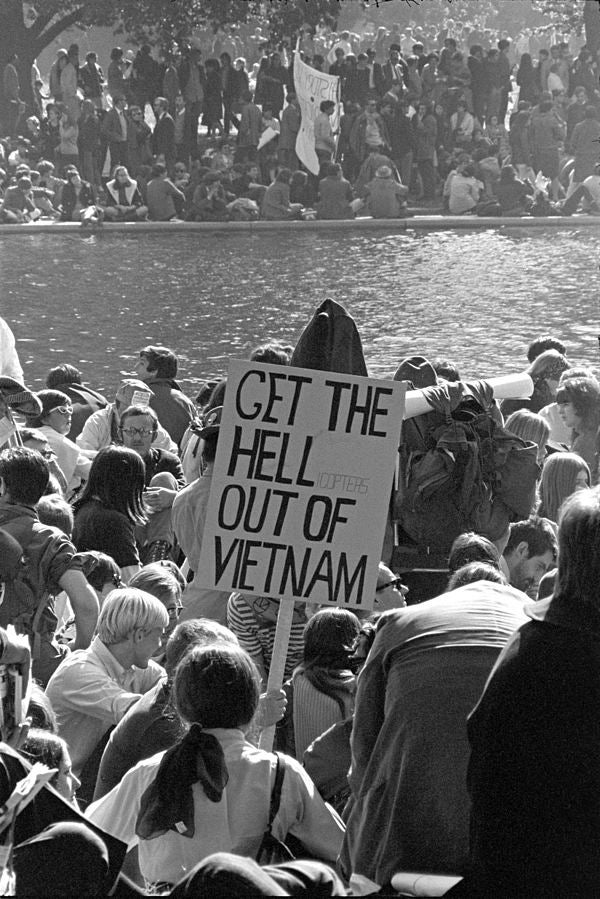
100,000 Americans gathered near the Lincoln Memorial and marched to the Pentagon to protest the Vietnam War. Among them: Allen Ginsberg, Norman Mailer, Dr. Benjamin Spock, and thousands of ordinary citizens who had simply had enough.
The protest was peaceful. The government response was not. 647 people were arrested. But the images — flowers in gun barrels, young women facing down armed soldiers with nothing but conviction — changed the world's understanding of what courage looks like.
"Rich Man's War,
Poor Man's Fight"
This phrase — used by Vietnam Veterans Against the War — captures the brutal arithmetic of every American conflict since the Civil War. During Vietnam, working-class and minority men were drafted at disproportionate rates. College deferments, medical exemptions obtained through private physicians, and National Guard placements were available almost exclusively to those with money and connections.
Secretary of Defense Robert McNamara's "Project 100,000" drafted young men whose qualifications were below draftable levels — running them through crash programs and sending them directly into combat. Meanwhile, professional athletes received physical deferments worth $100,000 a year.
The Flower Children did not need a PhD to understand this. They just needed eyes.
Source: Barry Romo, Vietnam Veterans Against the War, The Veteran, 1981
Jan Rose Kasmir confronts the National Guard at the Pentagon, 1967 — Marc Riboud / Magnum Photos
"In the councils of government, we must guard against the acquisition of unwarranted influence, whether sought or unsought, by the military-industrial complex. The potential for the disastrous rise of misplaced power exists and will persist."
— President Dwight D. Eisenhower
Farewell Address to the Nation, January 17, 1961
Eisenhower was a five-star general. The Supreme Allied Commander in World War II. The man who planned D-Day. And he spent his final moments in office warning America that the corporations profiting from war were becoming more powerful than the democracy they claimed to defend.
The Flower Children heard him. Did anyone else?
Love Is the Vehicle
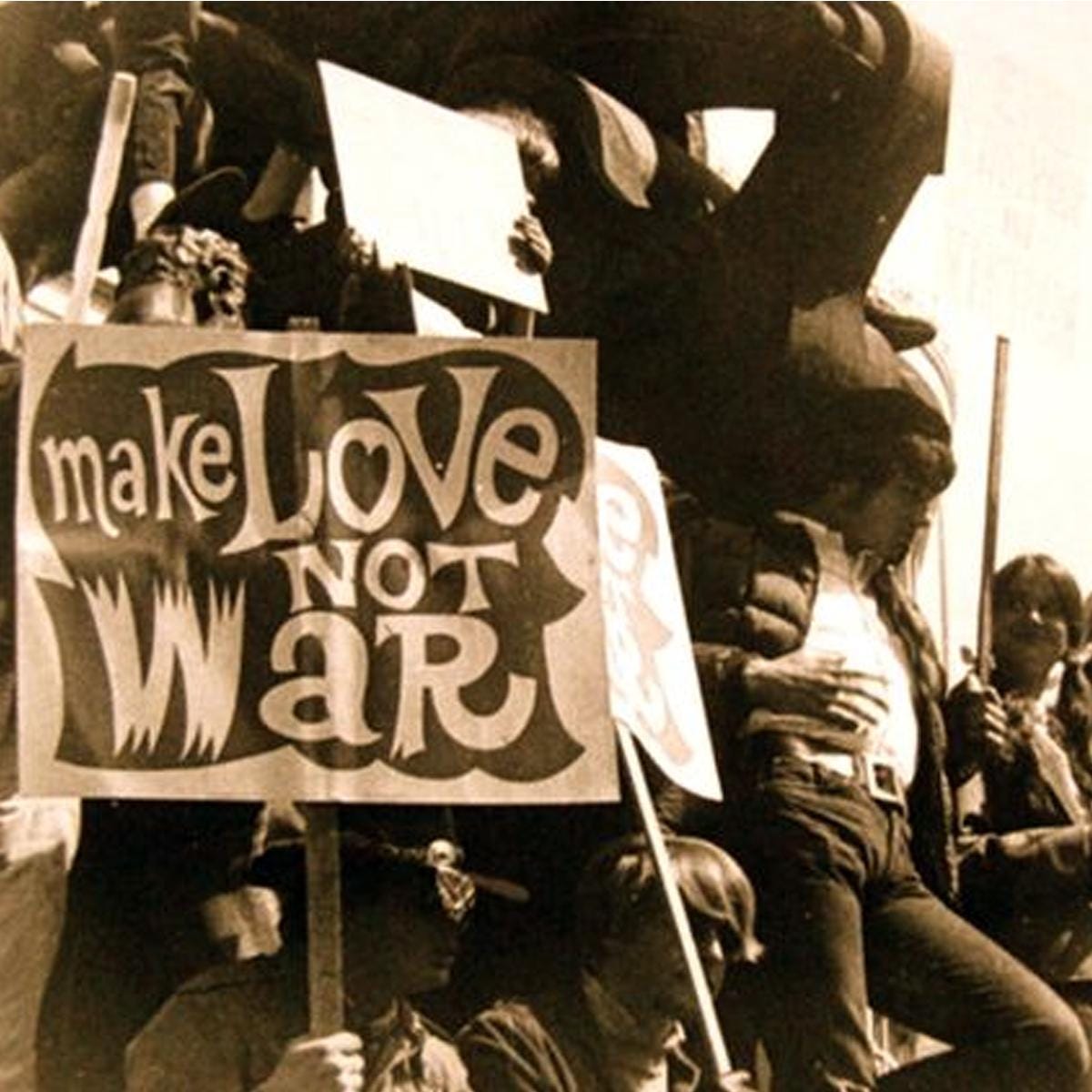
They painted their cars with flowers. They wore flowers in their hair. They handed flowers to soldiers. Every flower was a declaration:
"We refuse to hate on command."
The VW Bug — the "People's Car," affordable, unpretentious, foreign — became the symbol of a generation that rejected the chrome-and-gasoline mythology of American power. They chose color over conformity. Community over competition. Love over war.
What They Knew That We Forgot
The Flower Children understood something that took economists decades to formalize: war is a transfer of wealth. Public money flows to private defense contractors. Working-class lives are spent so that shareholders can profit.
They understood that the same system that sent their brothers to Vietnam was the system that underfunded their schools, polluted their neighborhoods, and told them to be grateful.
And they understood — perhaps most importantly — that the antidote to manufactured hatred is not neutrality. It is active love. Love that names injustice. Love that refuses to comply. Love that plants a flower in a gun barrel and does not look away.
They Said It Out Loud
Generals, champions, historians, and ministers — the most credible voices of the 20th century all said the same thing.
WAR is a racket. It always has been. It is possibly the oldest, easily the most profitable, surely the most vicious. It is the only one in which the profits are reckoned in dollars and the losses in lives.
— Major General Smedley Butler
War Is a Racket, 1935 — Two-time Medal of Honor recipient, most decorated Marine in U.S. history
Add Your Voice to the Wall
The most powerful voices may not be famous ones. If you are a teacher, veteran, parent, or student who has lived this truth, your words belong on this wall.
Why This Lives on TeacherWorld
Teachers are the inheritors of the Flower Children's mission. Every day, in every classroom, teachers are asked to prepare children for a world designed by the same forces the Flower Children protested — a world that values compliance over creativity, production over personhood, and profit over life.
TeacherWorld exists because the Flower Children were right. Love is not weakness. Truth is not naive. And the children in our classrooms deserve teachers who have not forgotten what the daisy in the gun barrel meant.
The Flower Children never stopped. They became teachers.