The Wheel of Suffering
How competition became the engine of human decline — and what chronic stress does to the teacher's brain.
The RE-CREATE board game is built around a wheel of five zones. When all five zones are alive, the wheel turns toward regeneration. When one zone collapses, the wheel begins to spin in the opposite direction. That opposite direction has a name.
The wheel is spinning. You can stop it.
Five zones. All five spinning in darkness. Fear, Isolation, Debt, Urgency, Disconnection.
The Architecture of the Wheel
The Wheel of Suffering has five spokes — each one a direct inversion of the five RE-CREATE zones. Click any zone to see the contrast.
Vitality, rest, nourishment
Joy, creativity, spontaneity
Authentic self, purpose, voice
Collective wealth, cooperative abundance
Belonging, mutual care, solidarity
Competition as the Engine
Competition, in its chronic form, is not a motivator. It is a threat signal. The human nervous system cannot distinguish between a lion in the savanna and a performance review. Both activate the same ancient survival circuitry.
Acute stress — a single competitive event — is survivable. But chronic competition — the kind installed in children at age six and maintained for sixty years — never allows the system to recover. The HPA axis remains activated. Cortisol remains elevated. And the brain begins to change.
This is not conspiracy. This is systems design. And it was installed in children at the kitchen table, at age six, with a board game called Monopoly — where the rule is simple: Last Man Standing takes all.
The Scarcity–Abundance Switch
Scarcity activates competition
Amygdala online → PFC offline → Fear drives behavior
Abundance activates cooperation
PFC online → Amygdala quiets → Purpose drives behavior
"Competition and cooperation are not equally activated by the same environments. The Wheel of Suffering is, at its core, a scarcity and threat machine."
What Chronic Stress Does to the Brain
The neuroscience is now unambiguous. Chronic competition produces measurable, structural changes in the human brain. This is not metaphor. This is measurable, reproducible neurobiology.
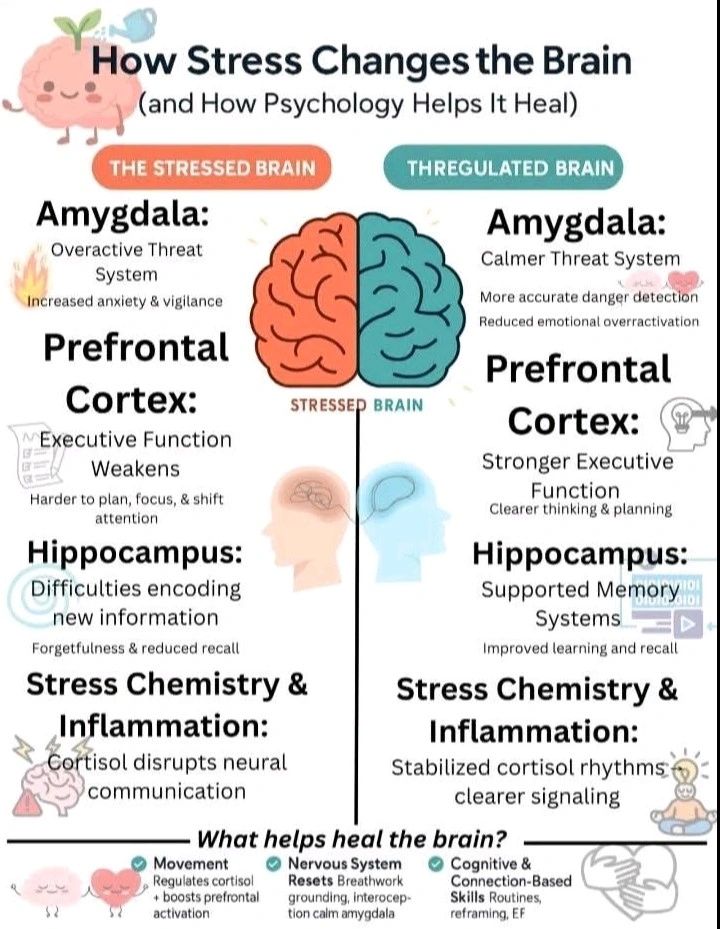
How Stress Changes the Brain — The Stressed Brain vs. The Regulated Brain. Source: Neuroscience research on chronic stress and brain structure.
The Wheel in Motion — A Teacher's Day
To understand the Wheel of Suffering in practice, consider a single day inside the extraction system.
6:00 AM
Wakes already in a state of low-grade anxiety. The amygdala, primed by months of chronic activation, begins scanning for threats before the first cup of coffee. Cortisol peaks from a higher baseline than a non-stressed individual.
7:30 AM
Arrives at school. Three emails from administration about test score data. One from a parent about a grade dispute. The HPA axis fires. The PFC, already compromised, struggles to formulate a measured response.
8:00–3:00 PM
Teaches five classes of 30 students each. Every interaction carries the implicit threat of inadequacy. The teacher is being observed, evaluated, compared, ranked. The entire environment is structured around competitive comparison.
3:30 PM
Professional development meeting. A new initiative — the third this year. The hippocampus, depleted of BDNF, struggles to encode the new information. The teacher feels stupid. The teacher is not stupid. The teacher's brain has been neurologically impaired by the system that is now demanding they learn faster.
6:00 PM
Home. Too exhausted to exercise (Body depleted). Too anxious to play (Play depleted). Too hollowed out to connect authentically (Community depleted). Too financially stressed to feel secure (Economy depleted). Too silenced to remember who they were before this job consumed them (Identity depleted). The Wheel of Suffering is spinning at full speed.
Five Re-Entry Points
The Wheel of Suffering, once spinning, is self-reinforcing. But it has five points of entry — one for each zone — and any one of them, when restored, begins to slow the wheel.
Restore the Body First
When a teacher begins to sleep, move, and nourish their body — even modestly — cortisol baselines begin to drop within weeks. The PFC begins to recover. Decisions become clearer. Patience returns. This is why the Body Zone is the first zone in RE-CREATE. It is not vanity. It is neurological infrastructure.
Reclaim Joy as Medicine
When a teacher laughs — genuinely, spontaneously, without agenda — the amygdala quiets. Dopamine and oxytocin flood the system. The brain registers: I am safe. The threat has passed. I can create. A single session of genuine play can shift a teacher's neurological state more profoundly than a month of professional development.
Remember Who You Are
When a teacher is asked — and genuinely heard — 'Who were you before the system told you who to be?' something shifts at a cellular level. The default mode network, suppressed by chronic threat, reactivates. The authentic, pre-institutional self begins to resurface. This is the Educere principle: not adding something new, but drawing out what was always there.
Remove the Financial Threat Signal
When the financial threat signal is removed — even partially, even through the knowledge that a cooperative safety net exists — the HPA axis begins to regulate. The brain stops allocating cognitive resources to survival and begins allocating them to flourishing. This is why the CareCo cooperative is not a financial product. It is a neurological intervention.
Return to Belonging
When a teacher sits in a circle with other teachers who truly see them — not as a performance unit, not as a test score generator, but as a full human being — the social nervous system activates. The vagus nerve, the great regulator of the parasympathetic system, tones. The body exhales. The Wheel of Suffering slows.
The Wells Are Open. Come and Drink.
The Wheel of Suffering was not inevitable. It was designed, installed, and maintained — and it can be dismantled, one zone at a time, one teacher at a time, one table at a time. The RE-CREATE game is the beginning of that dismantling. Not because a board game can fix a broken system, but because a board game can give a human being a lived experience of what the Bright Side feels like in their body.
References
[1] Knezevic, E. et al. (2023). "The Role of Cortisol in Chronic Stress, Neurodegenerative Diseases, and Psychological Disorders." PMC / NIH.
[2] American Brain Foundation. (2024). "How Stress Affects the Brain."
[3] Harvard Center on the Developing Child. "Stress Disrupts the Architecture of the Developing Brain."
[4] Girotti, M. et al. (2024). "Effects of chronic stress on cognitive function." Neurobiology of Stress.
[5] Salvador, A. (2009). "Coping with competition: Neuroendocrine responses and cognitive variables." Neuroscience & Biobehavioral Reviews.
[6] UAB News. (2025). "How chronic stress rewires the brain."
[7] Agyapong, B. et al. (2022). "Stress, Burnout, Anxiety and Depression among Teachers." PMC / NIH.
[8] Dudley, K. (2021). "Late Childhood Stress and Neurocognitive Development: Exploring the Role of School Safety." Doctoral dissertation.