The 800-Year-Old Garden
That Still Works Today
Before chemical fertilizers. Before industrial irrigation. Before Monsanto. The Aymara and Quechua peoples of the Andes built a farming system so elegant, so self-sustaining, that modern agriculture cannot replicate it — and in many places, the law will not allow it.
"The system that feeds itself, heals itself, and was nearly erased from history."
What Is Waru Waru?
Waru Waru (also called camellones in Spanish) is a raised-field agricultural system developed by pre-Hispanic peoples in the Andes region of South America — from Ecuador to Bolivia — beginning around 300 B.C.It is most closely associated with the Tiwanaku culture of the Lake Titicaca basin.
The system consists of raised planting beds alternated with water-filled canals. The canals collect rainfall, river water, and lake water. The raised beds — built from the nutrient-rich sediment dredged from those canals — become self-fertilizing platforms for growing potatoes, quinoa, and cañihua at altitudes above 3,800 metres (12,500 feet), where most crops cannot survive.
At this altitude, the Andean altiplano experiences brutal temperature swings: scorching sun by day, killing frosts by night. Waru Waru solved this with elegant physics — the canals absorb solar radiation during the day and release it as heat at night, keeping the soil approximately 1°C warmer than surrounding fields. That single degree is the difference between a harvest and a famine.
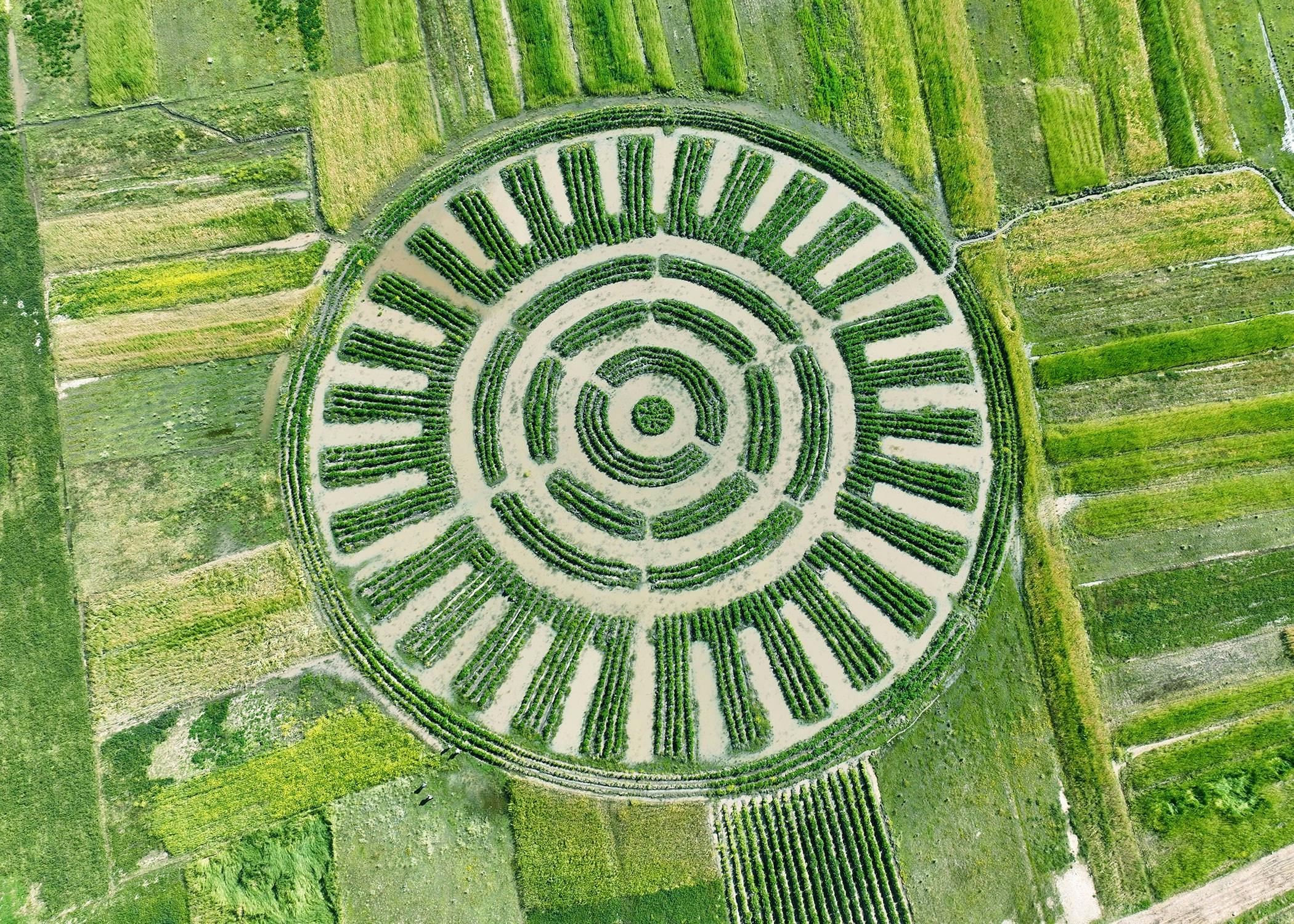
Aerial view of Waru Waru fields near Lake Titicaca — the concentric ring pattern reflects centuries of community engineering. Image: World Monuments Fund
The Five Engineering Miracles
Each feature of Waru Waru solves multiple problems simultaneously — the hallmark of systems designed by people who understood their land across generations.
Frost Protection
Canal water absorbs solar heat by day and radiates it at night, creating a microclimate 1°C warmer than surrounding fields. At 3,800m altitude, this single degree prevents crop loss from overnight frosts — without any fuel, electricity, or infrastructure.
Self-Fertilizing Soil
Aquatic plants, algae, and organic matter decompose in the canals, creating nutrient-rich sediment. Farmers periodically dredge this sediment onto the raised beds — a natural, recyclable fertilizer cycle that has been running for over 2,000 years with no chemical inputs.
Flood & Drought Control
During floods, excess water flows into the canals, protecting the raised beds. During droughts, the stored canal water irrigates the crops. The same system handles opposite climate extremes — a resilience that modern monoculture irrigation cannot match.
Biodiversity Creation
The canals become thriving ecosystems — attracting fish, lake birds, and beneficial insects. The Tiwanaku people did not just grow crops; they created entire food webs. The farm was also a fishery, a bird sanctuary, and a pest management system.
Zero External Inputs
No chemical fertilizers. No synthetic pesticides. No diesel-powered machinery. No imported seeds. No corporate supply chain. The system is entirely self-contained — powered by sun, water, gravity, and community labor. It cannot be monopolized.
Collective Architecture
Waru Waru fields were built and maintained through ayni — the Andean principle of reciprocal community labor. No single landowner controlled the system. It was a cooperative infrastructure, owned and operated by the community for the community.
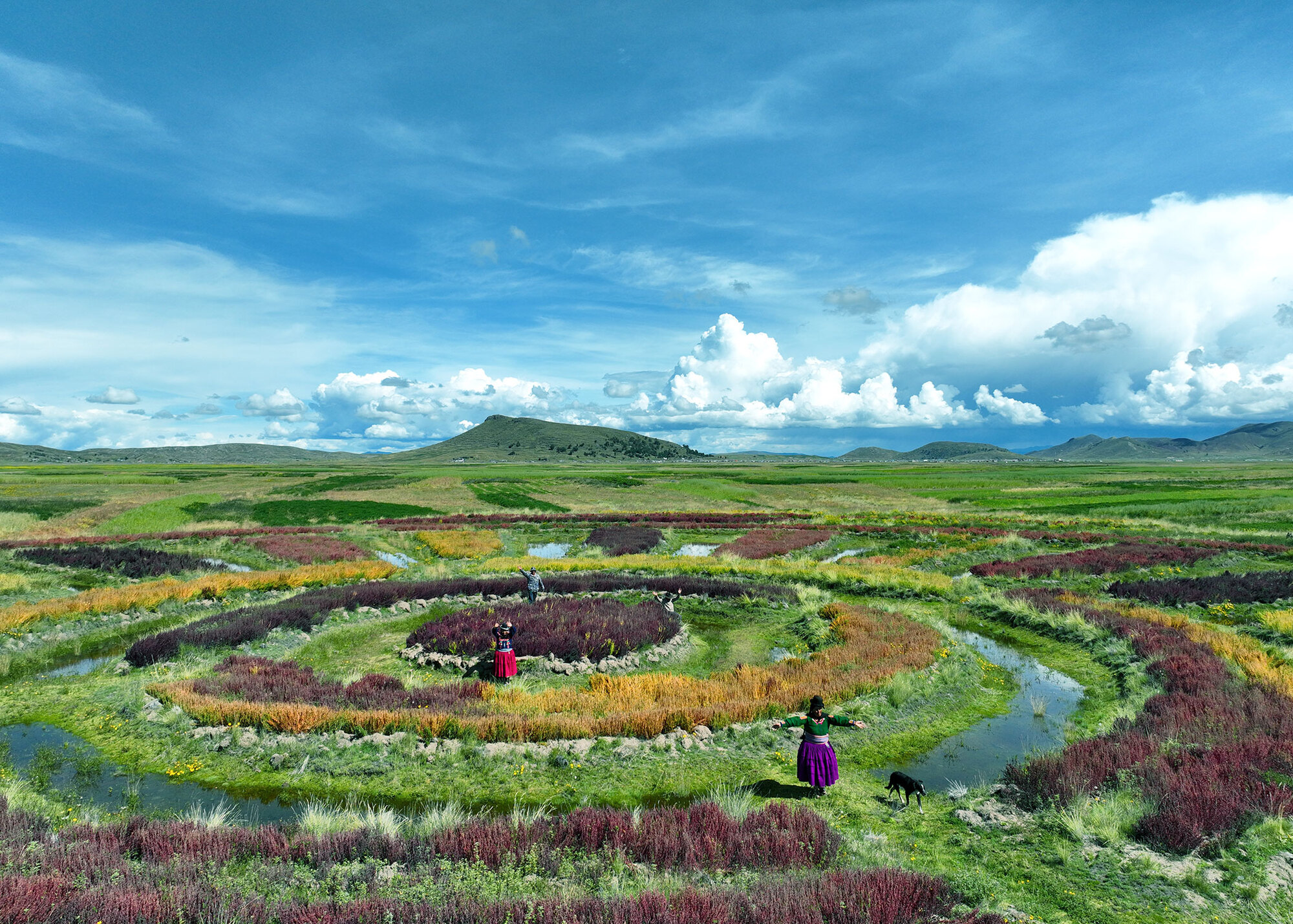
Aymara farmers harvesting cañihua in a Waru Waru field, Puno region, Peru.
Image: World Monuments Fund
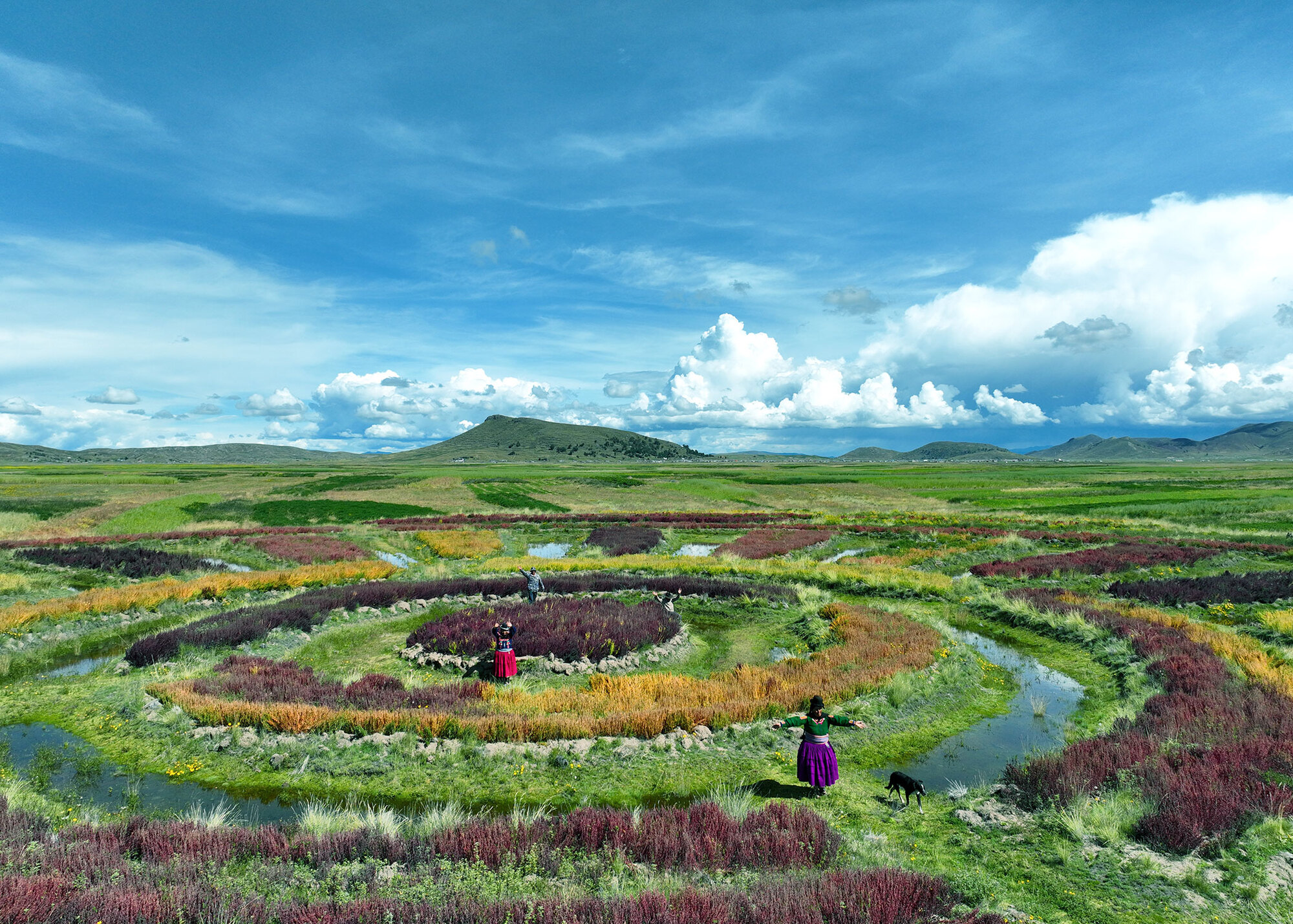
The canal-and-bed system visible from the air.
Image: World Monuments Fund
Why Was It Abandoned?
The Spanish conquistadors arrived in the 16th century. By the time they documented the Lake Titicaca region in detail, Waru Waru had already disappeared.
Forced Labor Extraction
The Spanish mita system conscripted indigenous men into silver and mercury mines. The community labor (ayni) that maintained the Waru Waru fields was redirected to colonial extraction. Without collective maintenance, the fields silted up and flooded.
Population Collapse
European diseases killed an estimated 90% of the indigenous population of the Americas within a century of contact. The knowledge keepers died. The engineers died. The farmers who understood the system across generations — gone.
Cultural Erasure
Spanish colonial administration actively suppressed indigenous agricultural practices, replacing them with European farming methods suited to the encomienda plantation system. The Aymara and Quechua languages — in which the knowledge was encoded — were suppressed in formal contexts.
Modern Water Law (The Legal Barrier)
In the western United States and many other jurisdictions, the Prior Appropriation Doctrine — the "Colorado Doctrine" — makes water retention systems legally complex or outright prohibited. Under this law, the first person to divert water from a source owns that right. Collecting or retaining water on your land can be treated as theft from downstream rights holders. Colorado only legalized rainwater collection in 2016.
Industrial Agriculture's Monopoly
Waru Waru cannot be patented. Its seeds are open-source. Its fertilizer is free. Its labor is communal. It produces no profit for chemical companies, seed corporations, or irrigation equipment manufacturers. A system that cannot be monetized has no lobby, no marketing budget, and no place in agricultural policy.
The Knowledge Was Dismissed
Until geographers William Denevan and George Plafker documented raised-field agriculture in the 1960s, the scientific establishment had classified the Amazon basin as "unable to sustain large-scale agriculture." The system had been invisible to Western science for 400 years — not because it didn't exist, but because the framework for seeing it didn't exist.
The Revival: Ancient Wisdom Returns
In 1984, archaeologist Alan Kolata of the University of Chicago began reviving Waru Waru in Tiwanaku, Bolivia and Puno, Peru. The results were extraordinary.
Revived Waru Waru fields produced dramatically higher potato and quinoa yields than adjacent modern fields using chemical inputs.
Radiocarbon dating confirms continuous use from at least 1000 B.C. to A.D. 400 — a 1,400-year track record of food security.
Aerial and satellite surveys have identified 82,000 hectares (200,000 acres) of abandoned Waru Waru fields in Bolivia and Peru alone.
In 2025, the World Monuments Fund placed Waru Waru fields on its 2025 World Monuments Watch — recognizing them as a living cultural heritage under threat from climate change, migration, and the continued pressure of industrial agriculture.
The Aymara Association Suma Yapu and the Regional Office of Culture of Puno are working with WMF to train a new generation of farmers in the ancient techniques.
Why This Matters for Teachers
The story of Waru Waru is not just a farming story. It is the story of what happens when ancient, community-held wisdom is displaced by systems designed for extraction, control, and profit.
The System That Cannot Be Patented
Waru Waru works because it belongs to everyone. No corporation can own it. No government can license it. No chemical company can sell it back to you. This is precisely why it was suppressed — and why it was invisible to Western science for 400 years. The same is true of the teacher wisdom encoded in the Flower Children generation: it cannot be standardized, tested, or sold. So the system dismissed it.
The FIDUROD Parallel
The Prussian factory school model — imported to America in the 1840s, codified by the Rockefeller General Education Board in 1906 — operates on the same logic as colonial agriculture: extract maximum output, suppress indigenous knowledge, replace community wisdom with corporate inputs. Just as Waru Waru was replaced by chemical fertilizers and irrigation infrastructure owned by corporations, teacher wisdom was replaced by scripted curricula, standardized tests, and compliance systems owned by publishing companies.
The Water Rights Metaphor
Prior Appropriation water law says: whoever claimed the water first owns it. The downstream community — the one that actually lives with the consequences — has no rights. This is precisely how educational policy works. The 'first in time' rights holders — the testing companies, the textbook publishers, the federal mandates — own the curriculum. Teachers, who live downstream with the actual children, have no rights to the water of their own professional wisdom.
The Invisible Knowledge Problem
Until 1960, Western science classified the Amazon basin as 'unable to sustain large-scale agriculture' — despite 2,000 years of Waru Waru evidence. The framework for seeing the evidence didn't exist. The same is true of teacher burnout: for decades, the system classified it as a personal failure, a character flaw, a lack of resilience. The framework for seeing it as a systemic design outcome — a predictable result of a Prussian extraction model — didn't exist. TeacherWorld exists to build that framework.
Ayni and the Co-Creator Culture
Waru Waru was built and maintained through ayni — the Andean principle of reciprocal community labor. No single person owned the system. Everyone contributed; everyone benefited. This is the model for TeacherWorld's Co-Creator Culture. The regeneration of teachers — like the regeneration of the altiplano — cannot be achieved through individual effort alone. It requires a cooperative architecture, built by the community for the community.
The Core Insight
"The most sophisticated agricultural system ever developed in the Andes was not lost because it failed. It was lost because the people who held the knowledge were killed, enslaved, and silenced — and the system that replaced it was designed to serve the colonizers, not the land."
Replace "agricultural system" with "teacher wisdom." Replace "colonizers" with "compliance systems." The sentence still holds.
TeacherWorld's Mission Is the Same as Waru Waru's Revival
Archaeologist Clark Erickson didn't invent a new farming system. He helped communities remember one that already worked. TeacherWorld is not inventing a new model of education. We are helping teachers remember the wisdom they already carry — the wisdom that was systematically suppressed by a Prussian-model factory school designed for compliance, not flourishing.
What Teachers Can Learn from Waru Waru
The principles that made Waru Waru work for 2,000 years are the same principles that make teaching sustainable.
Raised beds protect crops from frost
Psychological safety protects teachers from burnout
Canals recycle nutrients back to the beds
Community feedback cycles restore teacher energy
The same system handles floods AND droughts
Resilient teachers adapt to both crisis and calm
Biodiversity creates pest resistance
Diverse teaching approaches create student engagement
Ayni (collective labor) maintains the whole system
Co-Creator Culture sustains the whole school
Zero external inputs — the system feeds itself
VVS Teachers draw from internal wisdom, not external scripts
Sources & Further Reading
Erickson, C. L. (1988). Waru-Waru: An Agricultural Technology of the Pre-Hispanic Highlands. University of Pennsylvania Museum.
Kolata, A. L. (1991). The Technology and Organization of Agricultural Production in the Tiwanaku State. Latin American Antiquity, 2(2), 99–125.
Denevan, W. M. (1970). Aboriginal Drained-Field Cultivation in the Americas. Science, 169(3946), 647–654.
World Monuments Fund (2025). 2025 World Monuments Watch: Waru Waru Agricultural Fields, Peru. wmf.org
Iñiguez, A. (2025). An Ancestral Legacy with Modern Concerns: The Story Behind the Waru Waru Agricultural Fields in Peru. ArchDaily.
Sanchez de Lozada, D. et al. (1998). Raised Field Agriculture and Current Farming in the Northern Lake Titicaca Basin. Mountain Research and Development, 18(2), 137–149.